Pratidwandi (1970)

Pratidwandi (1970)
Jayshree Ray fixes her gaze on Central Calcutta in Satyajit Ray's Pratidwandi (The Adversary, 1970)

Tuesday, September 30, 2014

In Pictures: Mass Protests at Jadavpur University, by Ronny Sen

[The following photo-essay of the ongoing Jadavpur University student movement by Ronny Sen was originally published in bbc.com. This is a repost. For the original, see http://www.bbc.com/news/world-asia-india-29322789]
Students at Calcutta's Jadavpur University have been protesting for the past fortnight at the sexual assault of a female student. A government-appointed panel has begun an inquiry, but the students, upset over the universities' decision to call in police against the protesters last week, say that is not enough.
Photographer Ronny Sen went to find out why they are so angry.
Parnab Das
Parnab Das a 1st Year student of Masters in Comparative literature
What began as anger over last month's assault has snowballed into fury over the authorities' response. Protests have also spilled outside the university campus, and at the weekend up to 25,000 people marched through Calcutta's streets. Parnab Das is doing a masters course in comparative literature. "I am also teaching in a school and I plan to leave my job so that I can give my full time to this movement," he says.
Supratik Sur Roy
Supratik Sur Roy is studying a Masters course in Film Studies
Last Tuesday night, the situation came to a head when university vice-chancellor Abhijit Chakraborty called in police to quell a protest on the campus. Mr Chakraborty says he called in the police because he was under siege and had to be rescued. Dozens of students were injured and admitted to hospital. Supratik Sur Roy, a student of film studies, says it was "completely unacceptable" to send "commandos and police to beat up students who were protesting peacefully".
Upasana Chakraborty
Upasana Chakraborty is is an undergraduate 3rd year student of English at Jadavpur University
Ms Chakraborty, an undergraduate student of English, says she was present on the night and that police came inside the campus and beat up the students. She has alleged that her boyfriend was severely beaten up and suffered multiple injuries. The students are now demanding that the vice-chancellor resign and Ms Chakraborty says she will not give up protesting until he quits.
Prabuddha Ghosh
Prabuddha Ghosh is a MPhill 1st Year student of Comparative Literature
Mr Ghosh, an MPhil student of comparative literature, says: "I am proud to be a part of this movement. I was not present on the night when police came, but I wish I was there with my friends who were beaten up." The poster behind him, with the war cry Halla bol (Raise your voice), aptly sums up the mood of the protesting students.
Sanmit Chaterjee
Sanmit Chaterjee is a Mphill student of second year studying Woman Studies.
"We are not only fighting against the vice-chancellor, we are addressing other issues as well. We are fighting against many things like moral policing on campus, which is being forcefully imposed on us", Sanmit Chaterjee says.
Rupsa Sarkar
Rupsa Sarkar is a Mass communication and journalism student in a post graduation course
Ms Sarkar, a mass communication and journalism student, says: "I don't think our demand to the vice-chancellor for a proper investigation into the molestation was wrong. What was the reason to bring the police inside the campus? The students were peacefully protesting. We will fight against police brutality and until the vice-chancellor resigns."
Devi
Devi is an ex student, she passed out in 2012.
Devi is an ex-student who graduated in 2012. But the protests have seen many former students like her return to the university. Along with some other students, she has been painting and making posters which are being put up across the campus.
Prantick Das
Prantick Das is an ex student of Comparative Literature and Mass Communication in Jadavpur University

An ex-student of comparative literature and mass communication, Mr Das says he is here because he feels "very strongly" about the incident. "This could have happened to any one of us. Former students who are in different parts of the world are sending messages with their support and solidarity," he says.

#hokkolorob: A Photostory of the Ongoing Movement in Jadavpur University

[September 2014 saw the dramatic escalation of a localised student movement in Jadavpur University in South Calcutta demanding a fair investigation into an incident of molestation of a girl in campus to a huge movement of students, intellectuals and citizens of Calcutta that strongly condemned the authoritarianism and callousness the university administration displayed in handling the situation. This photo-essay was originally published in http://www.aneyezine.com/in-solidarity-a-photostory-of-the-on-going-movement-in-jadavpur-university/. This is a repost. For details regarding the initial student movement demanding a fair investigation and the punishment of the molesters, see http://kafila.org/2014/09/12/jadavpur-university-students-struggle-against-gender-violence/] 
'Students, tired after a long day of protest, unwind with music, and much-needed sleep as the posters scream in the darkness. A photostory in (mostly) multiple exposure, documenting the ongoing protests in Jadavpur University at night, on the 11th of September, taken between 2am and 4am.'

IMG_7295IMG_7296IMG_7396IMG_7393IMG_7391IMG_7380IMG_7376IMG_7374IMG_7359
IMG_7355IMG_7354IMG_7353IMG_7352IMG_7351IMG_7349IMG_7346IMG_7335IMG_7331IMG_7297

Prose of Power and the Poetry of Protest – An Outsider’s Attempt to Make Sense of the ‘Kolorob’ in Kolkata: Uditi Sen

[Following an incident of molestation of a female student in the campus of Jadavpur University in South Calcutta, the administration set up an internal investigation committee to look into the matter. Fearing partiality in investigation, the students raised their voice and demanded the inclusion of impartial non-partisan people in the committee. The adament administration, however, decided to ignore these demands. As the students gherao-ed (blockaded) the Vice Chancellor (VC) in his office, the VC called in the police, who lathi-charged (beat up with sticks) the peacefully protesting students up and manhandled protesting female students. In response to these police brutalities in an educational institution, Calcutta saw, in the second half of September 2014, massive spontaneous protests and demonstrations (which mobilised with the catchphrase hokkolorob, literally meaning 'let there be clamour') on its streets by citizens and intellectuals, led primarily by the students. The following piece, a sympathetic yet succinct analysis of the governmental rhetoric aimed at delegitimising the movement, and the language of the protesters seeking to counter these governmental narratives and present alternate visions of politics and democracy, was originally published in kafila.org on 28 September 2014. This is a repost.]

51288650-29337-hokkolorob
#Hokkolorob – Embodied
It’s been more than a week since tens of thousands of students marched in a rain drenched Saturday in Kolkata, in solidarity with Jadavpur University students and their fight for justice. Much has happened since to delegitimise this mammoth, genuinely popular and student-led march. A counter-march, the co-optation of the victim’s father by the ruling party, adverse propaganda in the press and fatigue and confusion amongst the protestors have been some of the dampening developments that followed the unexpected show of student power. True to their clarion call, hok kolorob (let there be clamour), the marchers made a lot of noise. A week later, as the numbers of protestors on the streets have dissipated as fast as they had congregated, it is perhaps time to step back from the euphoria of the gathering and the intimidation and murky co-optation of protest that followed, to reflect on the political meanings and potential of this uprising.

The march was not organised by any single political party, though many with experience or background in student politics of one ilk or the other, marched. The vast majority, however, were students who had never marched before and had no experience of politics. The question therefore arises, what, if anything is the unifying ideology of this body of protestors? What goals motivate them? Above all, the question that is doing the rounds the most, on social media, on mainstream news and on the streets is what are the politics of the protestors? The question of politics is seldom posed directly. Its ubiquitous presence, however, can be clearly read in the answers provided regarding the nature of the march, the motivations of the protestors and the identity of the marchers. Unsurprisingly, diametrically opposite sets of answers emerge from members of the ruling party, inside and outside Jadavpur University; and the people who took to the streets on Saturday. From the Vice Chancellor, the Education Minister and officially ordained leaders of the ‘youth’, such as Abhishek Banerjee and Shankudeb Panda, characterisations emerge that focus on indiscipline on campus, presence of Maoist and other outsiders and deep conspiracies. From students of Jadavpur University and their sympathisers, assertions emerge that this protest is about justice and not about politics. Both characterisations fail to capture what is at stake.
What we are witnessing, in the kolorob that has spilled over from Jadavpur University onto the streets of Calcutta, is a clear opposition between the prose of those in power and the poetry of protest. But this opposition is not between politically motivated speech and an ‘apolitical’ quest for justice, notwithstanding characterisations by mainstream media and the disavowals of spirited protestors. What is at stake is a disagreement over the limits of political power, the manner in which elected governments and executive authorities can rule and the expectations that people, ordinary people, can have of those who rule in their name. While these may not be issues debated or taken up with any seriousness by existing political parties in West Bengal that does not make them any less political, in the broadest sense of the word. A closer look at the poetry of protest reveals not just wit and catchy phrases, but a profound critique of the established patterns of party-politics, what I call politics as usual. Defending the status quo of politics as usual is the prose of power, a concerted and by now, predictable pattern of allegations and misinformation designed to delegitimise popular protest. A closer look at the slogans thrown up in Kolkata suggests that the poetry of protest is not just critical of the prose of power, but also carries embedded within it aspirations of a different, more just society, thus speaking, in hushed tones, of a politics of democratic possibilities.
Dismantling the Prose of Power: The Proud Outsider
The response of the authorities to the protest has followed what has become, by now, a familiar pattern. Every protest, every report of violence against women in Mamata’s Bengal is dismissed as choto ghotona (insignificant incident), shajano ghotona (a made-up incident) or chokranto(conspiracy). Such attempts to reframe and discredit genuine popular protest as either insignificant or a deep conspiracy by outsiders (bohiragoto) is eerily familiar in West Bengal. The allegation of being an ‘outsider’ was most famously and consistently mobilised by the Left Front government in Singur and Nandigram, as was the spectre of Maoism. Thus, despite a change in the identity of the ruling party, little has changed in the way those in authority relate to popular protest. It is clear, that neither the CPI(M), nor the TMC, once in power, have any space for popular movements that cannot readily be transformed into electoral gains. Despite whatever ideology might separate these two parties, they (and I suspect any political party that comes to power without actively seeking to dismantle the structures of domination that characterise West Bengal’s society and economy) share a common prose of power. The goal of this prose is to delegitimise popular protest. Its most obvious tool is language itself, backed by an entire machinery of propaganda and where necessary, some old-fashioned intimidation.
My attempt to map out this prose of power is heavily indebted to Ranajit Guha’s ‘Prose of Counter Insurgency’ that taught us to read self-avowedly neutral reports of peasant insurgency produced by colonial officials as texts entirely complicit in upholding existing structures of domination. Following Guha’s work, which taught us to read ‘revolt against zamindari’ whenever colonial reports spoke of ‘defying the authority of the state’ and replace allegations of ‘intention to attack’ with ‘intention to punish oppressors’; may we not also learn to read the present prose of power for signs of complicity? The process has already started, on the streets, with student protestors countering allegations of being outsiders or ‘bohiragoto’ with declarations of ‘ami gorbito, ami bohiragoto – pashe achi Jadavpur’, which translates as ‘I am proud, I am an outsider, # Standing with Jadavpur’.
Bohiragoto Card
‘Bohiragoto/Outsider ID Card’ – Circulated Online in Response to the Calcutta High Court Interim Order Restricting the Entry of ‘Outsiders’ into the Jadavpur University Campus
Thus, the poetry of protest takes the allegation of being from outside, being an illegitimate presence, and turns it into a proud presence of solidarity, an act of standing by friends/lovers/fellow students/fellow citizens. Surely, in future, it will be easier to read ‘proud presence in solidarity’ every time the authorities report ‘illegitimate presence of outsiders’ in a movement of protest. Neither the allegation of bohiragoto, nor its poetic refutation is new.
Bohiragoto - Poem by Shonkho Ghosh, widely used during the Jadavpur Protests
Bohiragoto – Poem by Shonkho Ghosh, widely used during the Jadavpur Protests
Shankha Ghosh’s brilliant poem by the same name begins by declaring ‘You don’t want to talk about me ? Then surely, I am an outsider’. But it is with the current kolorob that protestors on the streets have radically inverted the meaning of being a bohiragoto. They have made it into a fine thing to be, instead of a terrible and indefensible thing to be.
The authorities have made several other allegations of terrible acts/ways of being against students. Not all of the allegations have (as yet) met their match on the streets, in the poetry of protest. But all can be subjected to a similar inversion of meaning- a peeling away of the prose of power to reveal an idiom of protest- a fine way to be. Such an exercise has its uses for two reasons. Firstly, the prose of power is far from toothless. Its tactics and propaganda are designed to demoralise and its campaign in Kolkata has just begun. This piece is my humble contribution to the work of rendering its language toothless. Secondly, whatever action the authorities mark as terrible is what evokes the most terror in those who cling to the trappings of power at any cost; that which is demonised as indefensible is often also the very act against which the status quo has little or no defence. Thus a productive, might I even say, revolutionary, response against the allegations of those in power is not to plead or demonstrate innocence, but to embrace what one is accused of, but by its true name.
Bohiragoto Statement 1
Source: Bohiragoto-r Diary, Community Page on Facebook

[ Partial Translation: ‘Today it’s them, what guarantee is there it won’t be us tomorrow? To protest one does not need to be an insider or outsider. I had joined the march to fight against this tendency to divide. I will march again. In solidarity- Shubhrangshu Sarkar, Rupkala Kendra.]

The proud embrace of the label of bohiragoto, as an ally, as one who stands in solidarity with the oppressed, demonstrates this move perfectly. Besides slogans, t-shirts and banners, the protests in Kolkata have also led to a facebook page, the ‘Bohiragoto-r Diary’ or ‘Outsider’s Diary’, which has testimonies from protestors who are not students of Jadavpur, but who marched anyway and who stand in solidarity with their struggle. Through these testimonies, the true names of the much-demeaned outsider emerge – ally, compatriot, human, student, sympathiser.
The Bohiragoro's Diary (Outsiders' Diary) Facebook Page
The Bohiragoro’s Diary (Outsiders’ Diary) Facebook Page
This act of re-naming the bohiragoto is of vital political importance as it points towards what the proponents of a politics-as-usual fear the most – alliances, solidarity and unity across campuses and between disparate sections of society. For such a politics of solidarity to come into being, the presence of ‘outsiders’ is a must. The presence of the bohiragoto can even be read a sign of when a local, isolated act of protest starts becoming something larger- a movement with dreams of justice. And a movement is neither as easily ignored, nor as easily suppressed as an isolated act of protest.
Following this logic, beginning to list all that the prose of power denounces as terrible can create a check list of all that terrifies the authorities the most, and therefore, all the actions that must be embraced in their true name. Below, I have attempted an analysis of the most common allegation against the students – indiscipline, phrased variously as ‘nairajyo/arajokota (which roughly translate as lawlessness) and gundami (thuggishness). The attempt is to translate what the prose of power says into what it actually means, and also, to speculate what the true name of indiscipline might be in an idiom of protest.
Indiscipline Vs Autonomous Learning
Accusations of indiscipline have been the most common refrain used to delegitimise the protestors. Rather than go into the specifics of these allegations, I would like to get to the core of the authoritarian, top-down vision of education that enables this allegation to stick. Our education minister and state-ordained political leaders define education in the narrowest possible terms. The students are repeatedly told to ‘return to books’ and to ‘exams’ and thus restore ‘normalcy’ to campus.
[ Trailer of Film Adaptation by Q of 'Tasher Desh' Rabindranath Tagore's Visionary Anarchist Opera ]
The vision of disciplined education and campus life the authorities are evoking perhaps has its best expression in Rabindranath Tagore’s Tasher Desh (Country of Cards). The rules of that land evoked niyom or law/discipline above all else. ‘Cholo niyom mote, cholo niyom mote. Dure takiyo nako. Ghar Bankiyo nako…’ (Live by the rules, Don’t look Far, Don’t look askew).
In this vision of education, we have students as automatons, who stick to their prescribed roles: learn only what is offered for learning in classes and prescribed text books, and regurgitate that in the exams to win the necessary piece of paper that will be currency in the job market. Learning that cannot be converted to such currency has no value, if the authorities are to be believed. In fact, the prose of power would have values such as justice and all the skills that students can learn through organising excluded from the sphere of education.
Prose of power masquerading as protest at TMC sponsored counter-march. Translations below.  2nd From Left: We want education in educational institutes, not lawlessness. Hiding behind guitars is a deep conspiracy.  5th from left:  Alcohol and Marijuana are becoming scarce, the real reason behind songs of protest. Source: Shankudeb Panda’s Facebook profile
Prose of power masquerading as protest at TMC sponsored counter-march. Translations below.
2nd From Left: We want education in educational institutes, not lawlessness. Hiding behind guitars is a deep conspiracy.
5th from left: Alcohol and Marijuana are becoming scarce, the real reason behind songs of protest.
Source: Shankudeb Panda’s Facebook profile. Shankudeb Panda is the leader of the Trinamool Congress Student Organization

Organising outside classrooms, conversing with the administration, requires students to educate themselves in the structures of administration, the ins and outs of how to effectively communicate and make demands within a certain system, how to hold it accountable. These are the nuts and bolts of practicing democratic citizenship. Yet, these are devalued as they are not the students ‘job’- they have deviated from memorising and regurgitating texts into learning about how to practice democracy and stand up for justice. This is, indeed, a terrible thing. They are also learning through doing the skills of communication, public speaking, the challenges of working with and across differences, the risk that egos pose to any kind of organising and the resolve and creativity needed to preserve unity. These are also, clearly, terrible skills for students to pick up. Indeed, what can be more terrifying to un-democratic power structures than an informed and active student body that does not just learn from texts, but also from the world they live in? A student body that applies their skills with words and their intelligence in the pursuit of dreams of democratic administration and justice, and not just in the pursuit of a pay-check, is surely a fine development for any democratic polity.
The true name of indiscipline seems to me, to be autonomy – of thought and action. Far from not being a student’s job/role, autonomous thinking and learning that is aided by but not confined to books, is the very essence of education and what distinguishes it from ‘training’. Any educator worth his/her salt will tell you that our job is not to help students memorise relevant facts for an examination, but to teach them to think for themselves, in an informed and autonomous way. It is thus unsurprising that of the many cultural tropes used by students to describe themselves, one is of the students of Satyajit Ray’s Hirok Rajar Deshe, who were at the forefront of the crowd pulling down the king’s statue, a symbol of autocratic power. By evoking this trope, the movement that has spilled out from Jadavpur onto the streets, has inadvertently called out the authorities’ vision of education by its true name: mogojdholai, or brain-washing, which is designed to control and not to educate.
The prose of power is rich with allegations that lend themselves to this work of translation. This piece is inspired by and written in solidarity with the idealism of the students on the streets, and against an all-too-easy recourse to cynicism. So the list below is an open invitation to all to defang the prose of power through translations and re-namings.
Allegations/Claims of the Prose of Power(Terrible Acts)
Meaning/Intentions of Authority
Its true meaning 
Mod/Ganja (drinking and smoking marijuana) on Jadavpur CampusMoral Policing of Behaviour/Character AssassinationA rejection of puritanical codes of behaviour/Aspirations for Freedom (see image of graffiti below)
Girls in shorts/girls wearing tank topsGender policing through slut-shaming and victim-blamingAspirations of safety of expression for women and de-sexualisation of the female body
Disrespect of elders/professors/ administratorsAuthoritarian administration of student affairsDemocratic governance that includes student representation
#hokprotibad (let there be protest)Claims of protesting against student indisciplineA command performance of protest, filling the streets with TMC constituents. Intended to capture the political capital of being a dissenter (protibadi)#hokkyalano (let there be beatings) Hopes of beating into submissionautonomous student movements (I am indebted to TMC’s ‘youth’ and student leaders for providing this translation of their own actions)

Graffiti in Jadavpur University Photograp by Ronny Sen
This list is neither exhaustive, nor thought through. But it reflects my hope that in the kolorob in Kolkata, a new generation of students have begun to dream of a new kind of politics, rich with possibilities of democratisation, participation, equal opportunity and gender justice. These dreams and aspirations are not new, nor are they easy in a society riven with deep inequities of caste, class and gender. Moreover, these aspirations are expressed within a democratic structure where political parties have learnt to thrive on social inequities, rather than challenge the social status quo. This context of politics-as-usual, which relies of bullying, intimidation, hierarchy and propaganda, and is actually hostile to popular and autonomous aspirations of democratisation, brings me to my final and perhaps most vital act of translation.
‘Apolitical’ Protest Vs A Politics of Possibilities
In their desperation to protect their dreams of justice and democratic participation from becoming fodder for politics-as-usual, many students have claimed an ‘apolitical’ stance. In the immediate aftermath of the mahamichil (grand march) on Saturday, The Telegraph reported the presence of anti-government sentiments, but absence of ‘politics’. (JU-bagh at heart of city, 20 Sept). Many students, especially many who have sought to proudly embrace the tag ofbohiragoto have also hastened to embrace the label ‘apolitical’. (See example below.)
A Post on the Bohiragoto'r Diary Facebook Page
A Post on the Bohiragoto’r Diary Facebook Page
Yet, how can the demand for justice, the demand to be heard, the refusal to accept imperious or irresponsible behaviour from figures of authority, be anything but a political demand? These demands carry within them aspirations of a different, better society and a reworking of the relationship between the rulers and the ruled, where those in power cannot rule with impunity. This, at its core, is a deeply democratic and therefore political aspiration. It seems that an act of translation is necessary to make sense of this paradox: an idiom of democratic protest that has donned the garb of the ‘apolitical’.
SUCH A LOT IS WON WHEN A SINGLE MAN SAYS A NO
Life of Galileo, Bertolt Brecht, quoted by Riddhi Sen in ‘We The Young, We the Fighters’, an article in The Telegraph, Kolkata
Riddhi Sen is a student of class XI in the National Institute of Open Schooling, he is also an actor on stage and in films.

Ridhdhi Sen’s article in the Telegraph begins to get closer to articulating what this assertion of being ‘apolitical’ means for today’s youth. He identifies as a fighter, evokes Brecht, the power of saying NO to injustice, the potential of independence of thoughts and actions amongst the young and yet, distances himself from politics through the claim ‘we don’t need any political party to protest’. (We the young, we the fighters, 22 Sept). The disavowal of politics is clearly not a turning away from active participation in the fight for social justice. It is a distancing from existing political parties.
It seems a correct reading of the claim to be ‘apolitical’ would be a critique of ‘politics-as-usual’ and not an absence of political aspirations, such as justice and democracy. The poetry of protest thrown up in Calcutta expresses a deep dissatisfaction with so-called alternatives or options offered to an electorate by opposing political parties. Through poetry and art, the students were quick to point out that wildly varied official ideologies and pre-electoral posturing give way to but identical autocratic tendencies once in power. A slogan heard at the mahamichil last Saturday was ‘Alimuddin shukiye kaath, shotru ekhon Kalighat’. The Telegraph aptly translated this as ‘Alimuddin is a shrivelled stick, the new enemy is Kalighat (where Mamata lives)’, and yet failed to grasp its political significance. This is a new generation of protestors, for whom the rewards of politics as usual are insufficient. They are willing to call the bluff of the ‘establishment’ left and the right with equal passion. Though calling themselves ‘apolitical’ they are unwilling to be pushed out of the sphere of public protest or intimidated into giving up on their dreams of a different, more just society.
The concensus that emerges out of the Kolorob in Kolkata is thus one of deep disaffection with politics as usual. An ability to see through the competitive posturing of rival political parties to the self-serving rot within political parties that destroys democratic possibilities is neither new in West Bengal, nor unique to those who walked for justice in Kolkata last Saturday. What is new is a willingness to re-occupy the public sphere. What is new, is the willingness to share experiences, organisational skills and dreams of a better tomorrow across campuses, unmediated by the elders of established political parties. And in this space of sharing and organising, the seeds of a new kind of politics have been sown. This is a politics pregnant with new possibilities – of democratisation and of justice and of holding the elected accountable to the electorate. I hope that as the seeds of this new kind of politics takes root in West Bengal, those who identify as ‘apolitical’ today might eventually come to call themselves by their true name- idealists, fighters and dreamers of a politics of new possibilities.
Uditi Sen lives in a small town in Massachusetts, USA and teaches South Asian History at Hampshire College. She was active in student politics, with and without banners, at Presidency University and Jawaharlal Nehru University.

Monday, September 1, 2014

'You have a date with Calcutta; treat her like a lady and you will find her to be one': A G.I.'s guide to wartime Calcutta


Imagine yourself as an American soldier in the early 1940s. The war is on, and you have just been assigned to the India-Burma-Japan front. Your station will be Calcutta.

Jittery? Thinking how to get by on unfamiliar terrain? Worry not, G.I.! The Information and Education Branch of the US Army has just what you need. The perfect guide book, meant for none other than you!

Let's take a peek then, shall we? You are confused at the queer customs of the 'natives, are you? Well, here you go then:
THE LOCAL MAN: Being a Bengal he usually has no headdress. Of the Bengalis only the Muslim wears a fez, and even he does not wear one all the time. The Bengali is that chap who wears a sheet-like cloth which you will see draped about his waist and legs, with the ends of the cloth tucked between the legs - sometimes winding up in a flowing, folded end that hangs in front. The shirt-like garment is worn outside the lower one. (Remember those jitterbugs back home who thought they were starting a new fad by allowing their shirttails to hang outside their trousers?)

YOU LOOK AT THE INDIAN:You look at the Indian daily, you pass him on the streets, his life touches yours constantly. But do you actually see him, do you get a picture of what makes him tick, or do you brush him off in your mind as "That darn native who... ?" (He is an Indian, not a native, by the way - and you, being a non-Asiatic in a country where all such visitors are for convenience classed as Europeans, you are a 'European.') You do see that the Indian is different from yourself. Granted. But - do you see that that difference between the two of you does not give you a reason to criticize the Indian? Do you try to realize that the Indian's dress is not strange for India? Rather, it fits the climate here. The Indian thinks his turban to be sacred and does not want it touched. Is that silly to you? Okay, soldier, how'd you like to be back in the States sporting a new light-gray, snap-brim felt and have some stranger come along and casually reach up to finger it? When the stranger had picked himself up ... ! Many Indian women object to their hands being touched even in a friendly handshake. Perhaps you may feel the same way about the French custom of kissing you on both cheeks. Kissing you, the nerve of the guy! Everywhere, in streams, ponds, or under public fountains, you will see Indians taking baths by pouring water on themselves; although they have their own standards and their own instincts for cleanliness, a great number of Indians consider a bathtub to be dirty. Queer of them, isn't it? Ha ha! Some of our own States once outlawed the use of bathtubs as being immoral. To repeat, yes, the Indian is different. But instead of merely noticing that difference and judging it hastily, suppose we take a good long second look and attempt to understand the fellow's customs and ways of living. Remember, it is an age-old failure to laugh at things that you do not understand.

Yes, Calcutta is a great place to shop cheap, as you would notice. But what to buy? And where from? How would you get the best price? Well, let's talk about that then: 

'[SHOPPING] THE RIGHT WAY - AND THE WRONG WAY: 
There are two ways to buy in Calcutta (if buy you must); you can buy at FIXED PRICES or you can BARGAIN for merchandise. Certain reliable, well-established stores in the city have a fixed-price scale, which simply means that there is no lookout posted to watch for your arrival. In all the other stores and in the markets or bazars a deliberately high price is quoted you for an article, and it is then up to you to argue the price down to somewhere within reason - without in the process losing your reason. You seldom win. If you leave any shop in India confident that you out-smarted the salesman, then be sure of this: YOU DIDN'T! You can profit by the experience (paid for) of other American soldiers. Buy sound products in reliable stores at fixed prices.' 


TEXTILES:
Your number one buy in the Calcutta area. They're made in this vicinity, for one thing. Buy sarees, for instance. Sarees are the Indian woman's outer garment, a strip of cotton or silk some 54 inches wide and 6 to 8 yards long. Your girl can make them into dresses, coats or hangings. Or buy linens, lingerie, brocades - look over the shop's complete textile line for something that appeals to you.

Did you say you want to have some fun? Some drinkin' and dancin' may be? Well there you go then:


LET'S EAT:
Calcutta has some fairly glamorous looking and tasting dishes, but, naturally, the present food is not up to its pre-war standards. You will want to sample some Indian food and some Chinese items - and then you will be quite ready to hurry back to that good old American style of cooking. eat only at in-bounds restaurants. Even these you will find none too clean.


DRINKING: 
Bad news. You won't be too happy about the liquor situation in Calcutta; and yet the place hasn't reached the desert stage as yet. Good whisky is available on the black market, but you'd be a fool to pay the prices. Indian whisky, rum, and gin aren't too bad; but in the long run you will probably do both your mind and stomach a large-sized favor if you stick to that beer ration from the P.X. In the cabarets and restaurants you won't find the brandy-and-soda too hard to take; and you might like the gimlets (gin, lime juice & water) - or the John Collins. Some beer is available at Firpo's Services Restaurant on Old Court House St., if you get there between 1900-1930. It's a here-it-is, there-it-was proposition. For bottled goods try the Army & Navy Stores at 41 Chowringhee Rd., or Mookerjee, O. N. & Sons, 3,4,5 Lindsay St.

DANCING:
In Calcutta you will not find night clubs of the type you knew back home. In fact - no night clubs. However, there are a number of places where you can dance.   For E.M. there are regularly scheduled dances at the ARC Burra and Cosmos Clubs on Dalhousie Square, at the Continental Service Club at 12 Chowringhee Rd., at the Y.M.C.A. on Corporation St. Gals will be on deck. You can have fun. Check at any club for scheduled nights.   Other spots where a G.I. can go - but where he should bring his own partner - are the Winter Garden and the Princes Room in the Grand Hotel (some real jive music in the Winter Gardens), Firpo's in the block above the Grand, and the Great Eastern Hotel (Wed. & Sat. only).   For officers there are weekly or nightly dances scheduled in most of the private clubs. Members and their guests only.   Firpo's, the Winter Garden, and the Great Eastern Hotel are open to officers, too.
___

_________________________

Wondering what all this is about? It's is a guide from 1945 to wartime Calcutta for the American soldiers who were being dispatched to be stationed here. With a slightly patronising, yet surprisingly liberal tone, this guide discusses in details whatever these soldiers would be looking to negotiate, starting from the local climate, manners and customs of the people of the city, to places to go for dining, drinking and other entertainments. The guide to what to shop and how is especially detailed, with a separate section for buying souvenirs. Expecting that the soldiers would want to send mails regularly back home, it also discusses issues about postage. There is also a list of shops for purchasing dresses, films, jewellery, musical instruments, radios, shoes, sporting goods, as well as a range of dry cleaners, hairdressers, opticians, pharmacists, stationers and so on. Expectedly, it also has a map of the city:


Here is the complete book: The Calcutta Key. I will leave you with the opening note of the book then, from none other than Brigadier General R.R. Neyland, signed in Calcutta, 1945: 
TEEK-HAI

  Once I knew a man who grew up in Philadelphia but never visited Independence Hall located there. I know several New Yorkers who though they live in its shadow, have never visited the Statue of Liberty.   I hope it can never be said that you were in Calcutta and didn't visit the Burning Ghats, the Kalighat Temple, and some of the other - equally famous - sights which Calcutta affords.  If you come here with an open mind you will find Calcutta is "Teek-Hai" (Okay). Of course, it's just like visiting any big city back home: you can have a good time, or a bad time, depending on how well you take care of yourself.   Incidentally, the people here like us. They think we're all right. Thanks to the good behavior of the American soldiers who preceded you, a friendly welcome from these folks awaits you. If you behave equally as well, a similar welcome will await your buddies who follow you in here. 
  "Teek-hai ?"

P.S.: While we are on the topic of the G.I.-s going to 'exotic' locations during the World War II, listen to this beautiful number, recorded by the Andrews Sisters. It's called Rum and Coca Cola and is about US soldiers in the West Indies. It stayed on top of Billboard's U.S. pop singles chart for ten weeks in 1945.


Sunday, August 31, 2014

Eta Kolkata (This is Kolkata), by Kaveri Gill

[This piece originally appeared in Kafila on 22 June 2014. This is a repost. For the original, see http://kafila.org/2014/06/22/eta-kolkata-this-is-kolkata-kaveri-gill/]

Today comes the surreal news that anyone painting their house or apartment white or sky blue in Kolkata can claim a waiver on property tax for a full year, a horror conjuring up a city that looks like a crumpled weave of Mother Teresa’s saree. Now, towns of Regency England and the Cornwall coast have uniform building and color restrictions to maintain historical continuity, but this idea is more in the perverse vein of babus suggesting that the burning ghats at Varanasi be “white-washed” for “freshness”.
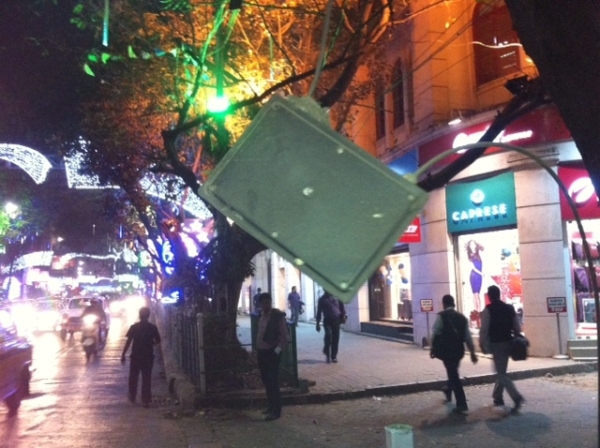
The Chief Minister's radio and music in public places scheme
The Chief Minister’s radio and music in public places scheme


Thankfully, another Humphrey shot that idea down, yet the decimation of the architectural integrity of the façade of these famous ghats continues apace, with sealed air-conditioned buildings overlooking the burning bodies at Manikaran. Bengal’s Chief Minister has been known to remark that the colours “promote happiness” and accordingly, the Trinamool Congress (TMC) Mayor has incentivised citizens to embrace the “theme colours of the city”[1]. Coming on the heels of a general election, where the TMC won 34 seats out of 42, up from 19 in 2009, and compared to only 2 each for the Communist Party of India (Marxist) and the Bharatiya Janata Party (with 18% of the vote share, not to mention an almost win in the city), even discounting for dirty tricks appropriated by their cadres from the Left of old, the scorn must be tempered by what this result says about the contemporary citizen of this state and city.
What it says is what bampanthi Bengali friends of mine, originally from Kolkata, never cease to tell me, when I am openly admiring and envious of the culture and milieu that is theirs – that it was theirs, but is no more (I’ll discuss the nostalgia-chimera effect below, theirs – Bhooter Bhabishyat – and mine!) I have come to accept what they insist on, that my eclectic and random sample circle is not representative of a population that is increasingly emulating the worst of the rest of India – conservative, censuring, consumerist, with closed minds, even casteist and communal by other genteel names. They are not alluding to Marwaris here, as central to the fabric of the city as the next native, but bhadralok Bengalis, with their share of arrivistes (as a Punjabi, this comforts me); those who’d gossip about single women; and worse, those not reading Gabriel Garcia Marquez, rather favouring to listen, not so secretly either, to pyaar pyaar pyaar hookah bar from Bollywood. These attitudes carry from Kolkata to CR Park in Delhi, as they would if one prefers to always carry the weather with one, to paraphrase the song. A look at Bengali popular television series, not very different in their regressiveness from Hindi serials, and I began to see why my friends are trying to remove my rose-coloured glasses.
But why, oh why, must this be so? Even as a non-Bengali, who had made only one previous visit during Durga puja to north Kolkata in the early 1990s and a fleeting day trip to present a paper at Centre for Studies in Social Sciences (CSSS) more recently, a leisurely stay in the city this past winter made me feel intensely nostalgic about its past, their past. Because for those with a certain sensibility, what Kolkata came to be (as opposed to what the British wanted it to be) is India’s finest past and losing it means a place of refuge, a dying but essential world, is gone forever. I am conscious I sound like a geriatric loyal life member of the India International Centre (IIC) here, but ceding and admitting upfront that all nostalgia has an element of sincerely remembered fiction and projection, that’s its very purpose, I see no harm in it. All the more reason for genuine natives of a similar aesthetic and politics, who take Kolkata for granted, as a place of psychological and actual belonging, a place that they can retire to when the rest of the world fails to deliver or falls apart, ought to sit up and speak up, or hold their peace forever. Its decline and disappearance will hit them harder than the rest of us in India, who have never had such a city – whether imagined or real, it doesn’t matter – to call one’s own.
If praise is in order to salvage, then here is what struck me about Kolkata on this recent visit. Some qualifiers are in order here. I stayed in the IIMC Joka campus, on the south-western edge of the city, or the Republic of Joka, as my Bengali hosts christened it, an independent metaphorical island standing in stark contrast to its environs. I walked the rest of the city, as much as I could – which does not include the new extensions of Salt Lake and New Town, only because I didn’t get a chance to visit either. My piece is a modest one, written as a complete outsider, with no prior connection to the place (and therefore, far from the perspective of an embedded insider, as Amit Chaudhuri’s or Indrajit Hazra’s recent books on the city portray). Having no baggage to a place frees one to sometimes see things – good and bad – that locals are blind or immune to, however, with a starkness and cold comparator gaze that begs documentation. That, alongside my research interests in urban and metropolitan life in India, compelled me to pen this sketch of a city, admittedly only experienced in a compressed amount of beautiful winter time.
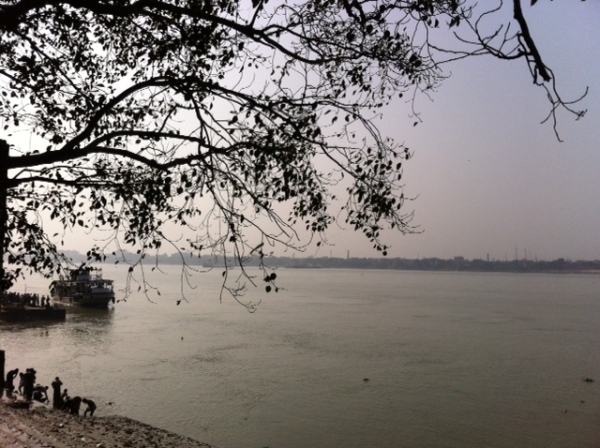
The Hugli
The Hugli river


The magnificent matriarch, bordered by the splendorous languorous Hugli, like a nonchalantly tossed pallu of a saree in freefall, cannot be described in terms that crudely focus on her inability to attract investment, or retain skilled white collar workers, functional attributes that can never explain a great city.  These might be necessary but are insufficient conditions, as an economist would crudely put it, to sustain and regenerate urban agglomerations over time, as will be found out in the many bustling metropoles (Bangalore) and flourishing satellite towns (Gurgaon and Noida) playing to the tune of just such a single-minded, instrumental piper.  A living, breathing space of beauty, densely inhabited by old trees growing out of old buildings, as much as people from all walks of life, Kolkata is a city no amount of urban planning could ever create or recreate, for it’s a space visibly contoured by and contingent on its past.
‘Compare, for instance,’ says Sir J. Strachey in chap. i of the 1903 edition of his India, ‘what Calcutta was when Lord Lawrence became Viceroy in 1864 and what it is now. This city, the capital of British India, supplies an excellent type of what has been everywhere going on. The filth of the city used to rot away in the midst of the population in pestilential ditches, or was thrown into the Hooghly, there to float backwards and forwards with every change of tide. To nine-tenths of the inhabitants clean water was unknown. They drank either the filthy water of the river, polluted with every conceivable abomination, or the still filthier contents of the shallow tanks. The river, which was the main source of supply to thousands of people, was not only the receptacle for ordinary filth; it was the great graveyard of the city. I forget how many thousand corpses were thrown into it every year. I forget how many hundred corpses were thrown into it from the Government hospitals and jails, for these practices were not confined to the poor and ignorant; they were followed or allowed, as a matter of course, by the officers of the Government and of the municipality. I remember the sights which were seen in Calcutta in those days in the hospitals, and jails, and markets, and slaughter-houses, and public streets. The place was declared, in official reports written by myself in language which was not, and could not be, stronger than the truth required, to be hardly fit for civilized men to live in. There are now few cities in Europe with which many parts of Calcutta need fear comparison, and although in the poorer quarters there is still much room for improvement, there is hardly a city in the world which has made greater progress”[2].
Today, I would say London ought to fear comparison with Kolkata (on dirt, filth and those other native abominations, as much as the beauty and grandeur of the buildings). For as a friend remarked, the British Empire could afford luxury and scale in the colony that they could not back home, and if India was the jewel in the crown, Kolkata was its first and finest cut (Delhi, I’m afraid, does not even come close). The magnificent General Post Office dome rising above the surrounding vista, taken with the fact that it is that very British thing called a GPO and not a paean of love such as the Taj Mahal, can only be an imperial imprint. The flat green expanse of Maidan, punctuated only by the canopy of trees that have witnessed the passage of time, and under which shelter people selling jhaalmuri to lovers and kids playing cricket, is just grand. Then there are the buildings of the Dalhousie area, or as it is now known, BBD Bagh (central business district and government center), each finer than the next, conjuring up tea and the sabre and thrust of commerce and speculation of the trading houses of old. Built to similar height, neither high rise and neither single storey – as is much of Kolkata – with civilised walkable alley space between two constructions, each would be a listed building, with a plaque of “Here lived so and so, from such and such dates”, were these in a richer region more cognisant of its heritage, such as Europe. Switzerland even celebrates fictional characters and their places, such as Heidi Land, as King’s Cross Station in London marks Harry Potter’s departure to Hogwarts on Platform 9 and 3/4ths.
GPO at dusk
GPO at dusk
Of course, there has to be balance, of not demolishing and burying one’s history, but equally, allowing a city to be a living, dynamic phenomenon. As our heritage would crush us, if that’s all we focused on preserving and maintaining, it’s wonderful to see the dense and equalising occupation of space, oriented towards cheap functionality, or as McKinseywallahs love to put it, efficient service delivery (albeit coming from the so-called ‘informal sector’, not a chain store). What else are the small shops selling puja-ware outside the Netaji Bhawan metro station? Or the chai ki dukaans in the midst of BBD Bagh, serving invigorating masala decoctions in Rs. 6 khullars, with Marwaris half in and out of suddenly stationary Audis, pulling out wads of cash in search of change, rubbing alongside pedestrian patrons, all patiently awaiting their turn while watching the stock exchange ticker in the background. I’m observing the peculiar police van, with its open grills, parked outside the Lal Bazaar police station, the sight of which heralded terrible things in the Naxalite movement times of the 1970s. For the narrow by lanes and galis of this city, in long shadows and short nights, have seen violence of an unprecedented kind for a metropolitan in modern times, one cannot forget. But today, with the bougainvillea flowering outside the Writer’s Building, which remains lal only in letter and not spirit, that seems a misplaced past. What seems closer, curiously, are the boulevards and expanse of the imperial imagination, at its finest in the “Race Course/Fort William/Esplanade” area, north of “Allipoor” and “Bhawanipoor”, as sketched in A. Upjohn’s yellowing map of the Kolkata of 1792 displayed in a moth-ball scattered glass display case in the Asiatic Society.
The Asiatic Society on Park Street
I visited the Asiatic Society of Bengal, “a British scholarly institution in the capital of British India”, in hot pursuit of an intrepid Hungarian traveler who became its librarian, whom I learned about from another idiosyncratic Bengali friend[3]. Most of them seem to lead dual cognitive lives quite seamlessly i.e. an exterior and an interior, or a real and an imagined etc., which makes it all so much more interesting and means their corporal selves might end up somewhere quite different to whence they commenced! Similarly, Alexandre Csoma de Koros (1784-1842) set off for Turkestan in Central Asia but ended up in the subcontinent, and it was said that “aggressive Sikhs” and their potential attack on the Ladakh valley [further] changed the course of his life, depositing him in the high mountains[4]. He went on to become the founder of Tibetan Studies, translating the first Tibetan-English dictionary and some Buddhist cannons, amid constant adventures of permissions and locations and elusive lamas. He gets a mention in Nicholas Roerich’s Altai Himalaya and Shambala writings:
“Lama, why do your priests claim that Shambhala is far beyond the ocean, when the Shambhala of earth is far closer? Csoma de Koros even mentions, with justification, the place—the wondrous mountain-valley, where the initiation of Buddha was held. I have heard that Csoma de Koros reaped misfortune in life. And Grunwedel, whom you mentioned, became insane; because they touched the great name of Shambhala out of curiosity, without realizing its stupendous significance”[5].
Of course, I felt a personal connection with him and had to pay homage.
The Asiatic Society is located at one end of Park Street, just before the Free Masons Building (tickles my fancy to imagine high Anglo-Saxon politicians rumoured to be among the society’s illustrious members visiting in stealth). Its old and new buildings lie connected by its own, open-air Bridge of Sighs, a worthy subaltern equivalent to the St Johns one in Cambridge and the New College one in Oxford, at any rate. Unlike many libraries and archives in India, where sheerbabudom keeps anyone without the requisite paperwork out, the head librarian accepted my host’s academic credentials in lieu of any identity card which would gain me a legitimate entry. Warming to my queries about Csoma – as she referred to him – she showed me his many entries in the reference card section of the new building, before marching me smartly across to the old building, to proudly point to his bust and rather basic writing room. Opposite him stood a portly polymath Ashutosh “Mookherjee”, mathematician and lawyer, after whom a College in Hazra is named. Both flank the musty, velveteen, old world Vidyasagar Hall, where the results of the first survey of this and that were set out in colonial times.
Back in the manuscript collection, a letter electing P.C. Mahalanobis as ‘Physical Sciences Secretary’ in 1924, is displayed right next to a Tibetan Smon-Lam-Sutra folio showing an exquisite miniature of a fierce deity, such as Vajrapani or Hiyagreeva, dancing in flames that represent the burning of the veil of ignorance, set against black handmade paper. Further along are some gems from Csoma’s Mahāvyutpatti (1831) Sanskrit Tibetan English Lexicon:
“”Priests! Like as gold is tried by burning, cutting & filing, the learned must examine my commandments (doctrine) and receive them accordingly, and not out of respect (for me)” – so spake Lord Buddha”. [On my host’s suggestion, I am reading Louis Althusser’s brilliant easy, On Limits of Marx, in which Marx is quoted as saying he is not a Marxist i.e. it is not an ideology that he has propounded, to be followed in blind faith! To the extent a religion is an ideology, the Buddha said it long before, is all I can think.]
“There is no eye like the understanding; there is no blindness like ignorance; there is no enemy like sickness; and nothing dreaded like death”.
I am arrested by a bust of James Prinsep – of the redeveloped waterfront Prinsep ghat fame – who is curiously made to look like an ancient Roman, with aquiline features and a toga flung over a shoulder. Off I go to the publication shop outside, which sadly does not have a copy of Csoma’sMahāvyutpatti for sale. The Asiatic Society should reprint its classic publications, the lack of which is felt by many a discerning reader, as they bought out some treasures in area and disciplinary side alleys in times past. I must make do with P. J. Marczell’s earnest two-volumes on Csoma, instead. As the Indian Museum is closed to due to extensive renovations, I wander into Park Street and stop at a roadside stall to pick up a tourist guide and map of Kolkata (Jui Juli Publication), which allows me to walk the city alone, and thereby make it my own. There are cheap reprints of Chetan Bhagat bestsellers lying alongside those of J. R. R. Tolkien’s The Hobbit – only in Kolkata!
The air-conditioning at Firpo’s is too chilly, and the queue for chelo kebabs outside Peter Cat’s too long, so I go across to Flury’s for open asparagus sandwiches and Viennese coffee. Assuming myopia rates are similar across the spectrum (not to fall into the cultural stereotypical trope of higher reading rates!), I notice many more women in Bengal wear spectacles than in the rest of the country. As one notices multiple race identities in Cape Town (black, white, coloured, Indian etc.), I’m struck by the mixed population of bhadralok Bengalis, Marwaris, Anglo-Indian and Chinese-origin customers, representative of various communities who call Kolkata home, I suppose. My Bengali friends point out that the numbers of ‘others’ used to far exceed what they are today, to the detriment of the city’s cosmopolitan nature. To a frontier Punjabi this seems a real pity, as we are good at absorbing and being absorbed, for we’ve learned that the rising tide at the shore arrived at and the shore abandoned – propelled by migrant and immigrant labour – raises all boats. I say white channa, you say ghugni and so it happily goes.
Stepping out into what at dusk is a merrily lit Christmas Champs Élysées, even though Jesus’s birthday has passed long since, I set out for the South Park Street Cemetery. If the Chief Minister has redefined Keynesian government spending to mean mood lighting for the depressed masses, who am I to complain? Her other unique Keynesian scheme, of uplifting music via radios in public spaces, is visible in dangling contraptions hanging at periodic intervals from the trees, literally at a height where one could unwittingly get bopped on the head by one (or electrocuted, should it be raining?) Melodious sentimental Rabindra sangeet is gently wafting out into the atmosphere, sadly drowned out by the sound of taxis zipping past. An attempt to cross the street is quickly abandoned, as unlike other cities of India, a competition on risk seeking versus risk averse behavior, illustrated by the pedestrian gingerly stepping into the midst of moving traffic holding their hands out in a makeshift supplicatory stop-sign, is likely to end up with one being killed in Kolkata. If one absolutely must cross the road, then shadow the locals closely, even using genteel old ladies in their beautiful jamdanis as de facto human shields!
Continuing with my spell of good luck with staff at places of public interest being understanding and indulgent of the curious, by the time I arrived, it was as Tom Waits would croon Closing Timeat the South Park Street Cemetery, but the caretaker allowed me in, to stay on until I’d seen the place. Set amidst lush foliage and odd-shaped large gravestones, William Jones’s resting place is impressive. In an inversion of the scene from Passage to India where Adela and Mrs. Moore are each in their own way spooked by the Marabar Caves trip with the native Aziz, I am very unnerved by the ghosts of the many British officers and their wives, some dearly departed in their early twenties as they clearly couldn’t withstand the strains of colony. I’m relieved to get out and return to the very here and now Behala Bazaar, and tomorrow, to brown ghosts ofzamindar north Kolkata.
Armed with my map, I decide to take the metro from Kalighat, only slightly smarting when recalling my friends’ laughter at my earnest query about how come the next stop, Jatin Das, is named after the artist, who is spotted regularly at the IIC in Delhi? It’s evident that the prettily-tiled metro is used very heavily, for there is a separate queue for those with exact change. Getting off at Shyambazaar metro, I walk down to Bagbazaar ghat.
Shyambazaar mansion in north Kolkata
In Bhooter Bhabishyat there is a throwaway line about the “two hundred year old mansions of north Calcutta and the art deco ones of south Calcutta” (around Deshapriya Park and Rashbehari Avenue, I imagine, as a friend has walked me through their beguiling leafy surrounds), but nothing has prepared me for the sight of these stunning traditional homes, with Venetian blinds and old trees intertwined naturally with the walls and structures. Peeping into narrow by-lanes that demarcate homes, the shadows cast on a supine sleeping dog or a Punjabi-dhoti-clad pundit mounting his bicycle, I wander past hole in the wall shops selling Bengali wedding bangles. A temple, some railway tracks, and one begins to feel the breeze of the mighty Hugli. Just as seaside cities have a sense of freedom and the vast unknown, riverside ones have a sense of calm and expansive refuge, so “you can keep your head when all about you / Are losing theirs and blaming it on you”, as Kipling put it. A little known fact about the city shared by my host is that gasping, choking waterways run the entire length of it, so an imaginative transport minister could actually conceive of reviving such a friendly mode of getting about – then Kolkata would have not only the Villa Borghese’s of Rome, many of them, but some of the romance of Venice, too!
I flag down a cab to take me to College Street, but after a short ride, during which the taxi driver tells me “profiteering” under the Left happened much as it is under the TMC (show me a city where a blue collar worker uses exactly this English term – please don’t be predictable and say Havana – and I’ll change my politics!), he deposits me near a tram stop. Startlingly honest, he explains a TMC rally means streets are clogging up and the Vidhan (Sarani) tram will be faster and cheaper. Just like trams in Europe, although this one could do with some paint, I trundle along with mothers, children and the odd student, the conductor having politely taken my Rs. 2 fare and given exact change. Contrast and compare with recently experienced toll booth behavior in Uttar Pradesh, where venal louts are forcibly dispensing aloo bhujiya packets worth Rs.2 in lieu of Rs.5 change, take it or leave it – and then we wonder at the governments who come to power, is it any surprise given the number of seats that state accounts for in Parliament? Asinine administrators that Kolkata appears to have at present, mean trams are being discontinued and the expensive land on which central tram depots lie is being auctioned off, as the deeds are apparently very clean and organised, thanks to white ghosts and their penchant for order and documentation.
Forensics' building in Medical College, Calcutta
Forensics’ building in Medical College, Calcutta
Lackadaisical lunch at the India Coffee House on College Street follows, enveloped in cigarette smoke despite prominently displayed signs saying the activity is prohibited. I’m intrigued not just by the book sellers peppering the street outside – now selling more texts and fewer rare books – but by the many ‘publishers’, who I later learn are actually functioning independent presses. Imagine that! A stroll through Sanskrit College, Presidency, and then through the red brick Calcutta Medical College and Hospital, is a must. Once I’m past the odour of the open waste dumps in the premises, I see the most incongruously beautiful forensics’ building en route to Central metro station. I think of the dead body of a poor woman lying at the edge of the Maidan ground the other day, passersby giving it wide berth. No one appeared to be missing her. And yet, as cruel a metropolitan city as Kolkata is to the marginalised, as are all metropolitan cities (Mother Teresa wouldn’t have had a job otherwise), I haven’t seen one in contemporary India or the world in fact, where they are so integrated and interwoven, literally, into its fabric. For in many cities of the developed world, there is de facto segregation (homeless, mentally ill, predominantly black people in Washington DC come to mind) and in others, they have been forcibly shunted out and made to disappear en masse to the peripheries (for instance, due to Ahmedabad’s waterfront development project or Delhi’s Commonwealth Games). From footpath dwellers, who have carefully and neatly carved out their ‘work’ and ‘living’ space in one, and stall owners, who redefine the word “cubby”, to the fact that one can eat a decent meal for Rs. 25 or even less on the street – all point to a dense coexistence, born out of codependence, of every class of citizen of the city.
A footpath dweller neatly carves out space
A great city must have its share of eccentrics or what is the point of it? Mullick’s Marble Palace is ode to such an acquisitive character, a wealthy merchant of the nineteenth century with a penchant for collecting ‘art’. Nondiscriminatory in his fancies, the imposing house with a lot of marble is said to boast of a handful of Rubens, Reynolds and a Titian or two, each framed without glass and therefore exposed freely to the elements, as well as the smoke from havans in the open central courtyard wafting through the Venetian slits. Those in the know, the highbrow sniffy set, are certain they are not originals, but surely, such nonchalant upkeep even of very deceptive fakes is a subaltern watermark for a truly shahi lifestyle? Scattered through the dark, dank halls of display are large objects d’art from the Orient, including ornate vases and screens, placed next to European curios, from statues representing the seasons, to those representing the planets. Outside, birds in cages lining the verandah are producing a cacophony of sound, and in the garden, in whichever direction one’s gaze falls, there are Grecian busts and majestic lions on plinths. We sadly don’t make it to the live zoo on the premises. Speaking of ghosts and eccentrics, I wonder if for all those who believe the revolutionary son of the soil, Netaji Subhash Chandra Bose, is still alive and in hiding (as many in Kolkata do, there is even a society or two for such faithfuls), there are at least a few who believe Raja Rajendra Mullick, too, is somewhere and somehow keeping a close watch on his whimsical property and many bric-a-brac belongings.
Another hallmark of a great city is one that is walkable and that, Kolkata still very much is – no matter that the broad footpaths are in disrepair in places and that locals say it is a more unsafe place for women in recent times. There isn’t a city in India where I have felt so unobserved and comfortably invisible whilst in public places, even after nightfall. If I’d had more time, I’d have made it to the Department of Economics, Calcutta University, where stalwarts such as Kalyan Sanyal chose to stay. I missed seeing the much written about Sonagachi, and the cultural hub around the Nandan area. I didn’t get to visit the National Library, although the Municipal Office building on nearby Belvedere Road in Alipur has to be one of the most striking to be inhabited by pedantic local government babus. After a lifetime of anticipation, a pilgrimage was made to Chamba Lamba’s in New Market, and it did not disappoint. I made time for numerous dois at the famous Sen Mahasay, naturally, and lots of aloo fritters in street side stalls, too. The image of Tipu Sultan’s mosque in Dharmtalla, at dusk, and the Jewish businessman Ezra’s mansions in Esplanade / BBD Bagh area, will stay with me. I witnessed nightfall and the city’s skyline from the rooftop bar at the Lindsay Hotel, though a visit to Khalasitola eluded me. I circumambulated the Lake Area and visited Buddho Mandir at its edge. I did a lot; I could have done so much more.
It was time for me to go to Bolpur Santiniketan, via lush green Bardhman district and onwards tolal maati Birbhum, following my favourite aloo posto and Baul singers, maybe even to Nadia district. Who knows, to chance upon the ghost of Lalan Fakir. And I realise, Kolkata has cast a spell on me, and I am as prone to the Bhooter Bhabishyat nostalgia about it as are my best Bengali friends. As the poet Shankha Ghosh wrote, “There is another Kolkata within Kolkata, walk and discover it” (“e kolkatar majhe ache arekta kolkata / hente dekhte sikhun”), perchance to dream.
Kaveri Gill writes and lives in Delhi

[1] Hindustan Times (Delhi edition), 9 June 2014.
[2] Imperial Gazetteer, Vol. 4, p. 474.
[3] The Hungarian Who Walked to Heaven by Edward Fox (2001), Short Books, p.1.